
What Fabric Lasts in Cat Toys: Durability Science
By Tariq Hassan • 19th Feb
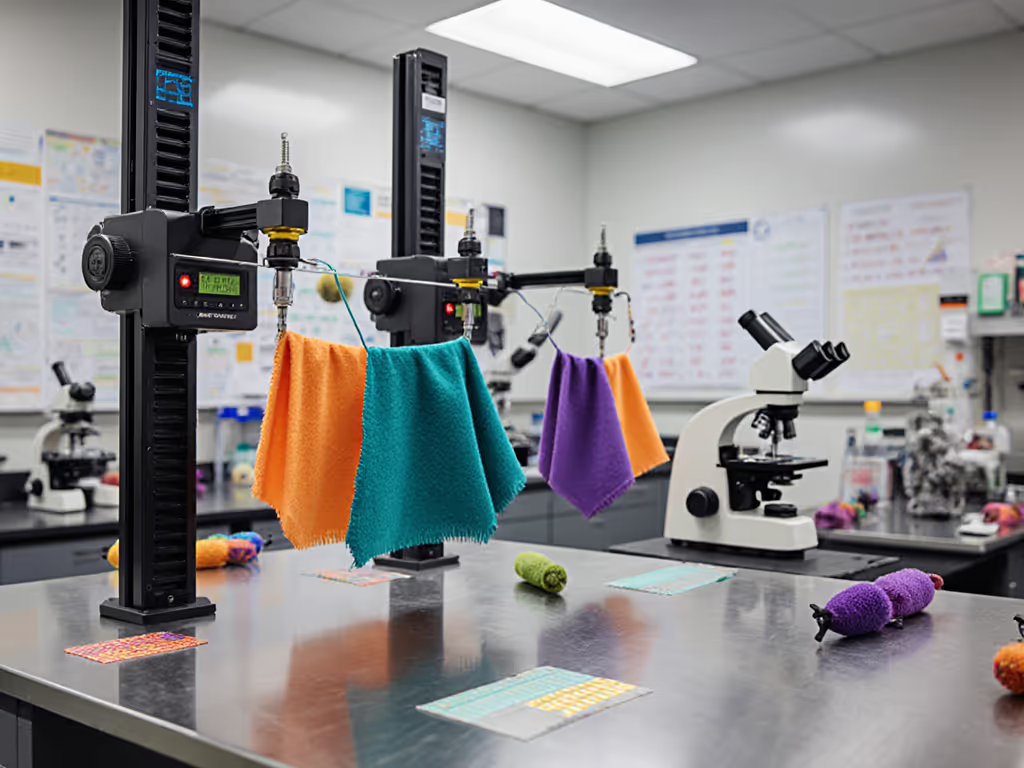
Cat toy materials science and fabric durability testing aren't glamorous topics, but they directly determine whether your cat's toys survive three days or three months, and whether they're safe to use at all. Most cat guardians buy toys hoping they'll last; fewer understand why certain fabrics fail or what makes one toy durable and another a shredding hazard. This article breaks down the durability truth behind cat toy materials using the same testing frameworks that manufacturers and laboratories actually employ.
Why Does Fabric Durability Matter for Cat Toys?
Before diving into testing protocols, let's establish the stakes. A toy that delaminates, tears, or sheds loose fibers becomes a risk flag (swallowed string, choking hazard, intestinal blockage). Even toys that don't break completely can lose their structural integrity under stress, becoming either boring (lose their prey motion) or dangerous (exposing sharp edges, loose stuffing, or fragments).
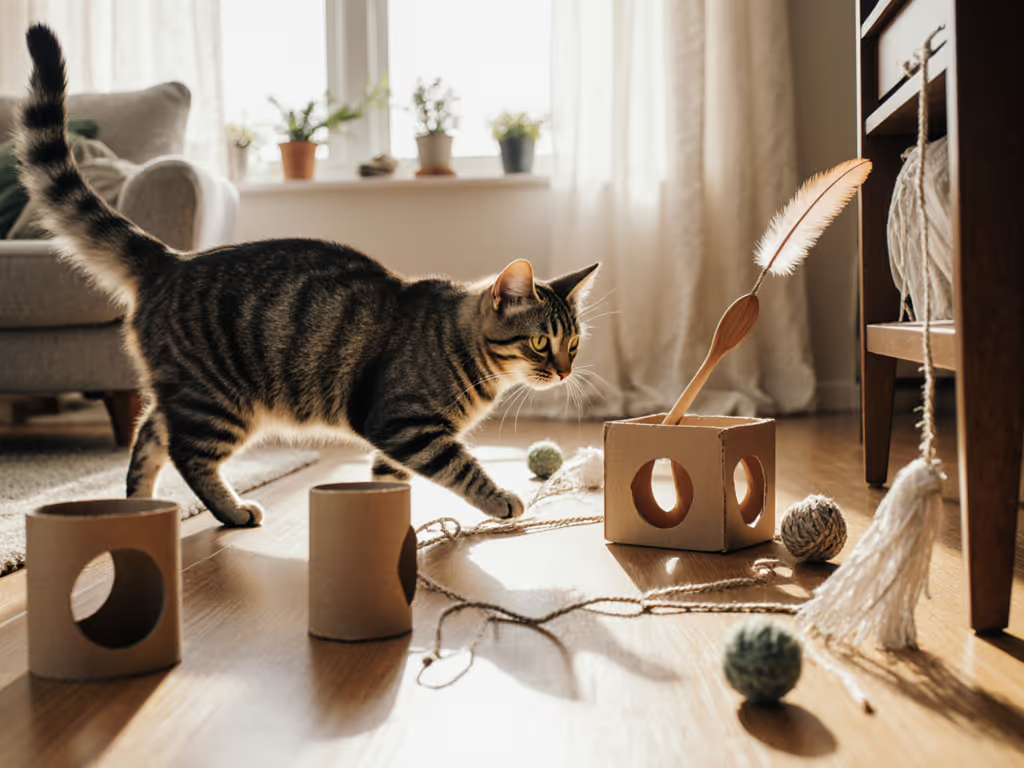
From my time working in shelters, I saw how failed toys created a domino effect: a cat loses enrichment, arousal spikes out of sync with actual hunting opportunities, play cycles become chaotic or aggressive, and multi-cat households start showing tension. The reverse is also true: a durable toy that holds up through repeated sessions allows the full predatory sequence to complete cleanly: stalk, chase, catch, eat (via food reward), groom, sleep. That closure calms the nervous system. For a deeper look at why completing each phase matters, see our prey sequence play guide. So fabric durability isn't just about longevity; it's about enabling a complete behavioral protocol.
What Testing Standards Apply to Cat Toy Fabrics?
You may have heard of ASTM F963 or ISO 8124 standards; these are primarily child toy safety frameworks[1][5]. If you're evaluating labels, learn to decode toy safety certifications beyond marketing claims. But pet toy laboratories employ similar mechanical stress testing adapted for how cats actually use toys. Labs like TTL Laboratories and QIMA conduct bite testing, tensile strength, torque testing, and small parts testing (the same core protocols used for children's toys but calibrated for pet-specific risks[2][4]).
Here's what happens in a typical durability test:
- Tensile strength tests measure how much pulling force a fabric can withstand before it tears or a seam separates[1].
- Bite and tear tests simulate puncture and shearing damage: what happens when a cat's canines or claws apply focused force[2][4].
- Compression and flex tests evaluate how fabric holds up when crumpled, batted, or compressed against a cat's teeth[4].
- Durability and fatigue testing runs samples through hundreds or thousands of cycles, effectively aging the toy weeks or months into a few hours[4][6].
Visual inspections also matter: testers look for cracks, delamination, loose fibers, and adhesive failures[1]. A toy might pass initial strength tests but fail a week later if the glue holding seams together degrades.
Which Fabrics Fail Fastest in Real-World Cat Play?
The short answer: thin synthetics, loose weaves, and fabric bonded with weak adhesives. Here's why.
Many low-cost toys use polyester microfiber or thin felt bonded to foam with hot-melt glue. These materials fail under repeated bite pressure and flexing: the adhesive creeps, the fabric lifts at edges, and shredding begins. Single-layer nylon and acetate are similarly vulnerable; they tear easily under claw pressure and don't recover from deformation.
The critical flag: toys labeled generically as "plush" or "soft" without material breakdown often hide cheap bonding methods. A plush toy manufactured to European safety standard BS EN 71-1:1998 must withstand 90 Newtons of pull tension[3], but many mass-market cat toys don't meet even that baseline.
Woven fabrics (as opposed to knits or felts) tend to perform better because the interlocking yarn structure distributes stress across multiple fibers rather than concentrating it on single points. Denser weaves = longer wear life.
What About Multi-Layer Construction and Seams?
A toy's durability depends as much on how it's built as what it's built from. Seams are stress concentration points. A toy with flat-locked seams (stitched from the inside, finished edges) will outlast one with simple overlapping seams. Double-stitching, bartacked corners, and reinforced attachment points all extend lifespan and reduce the risk of small parts detaching[1][3].
Multi-layer construction (outer fabric + intermediate stabilizer + foam or filling) distributes damage. If the outer layer tears, the inner layers may still contain any filling material. Single-layer constructions fail catastrophically: one tear propagates fast.
Here's a protocol tip from my shelter observations: toys with bonded outer layers (no stitching) fail faster than fully stitched designs. Heat-sealed or glued seams peel under stress; thread holds. If you're selecting a wand toy or crinkle toy, favor sewn construction over glued.
How Does Stuffing Material Affect Overall Durability?
The outer fabric is half the equation. What's inside matters too. Toys filled with loose poly-fiberfill shed easily and absorb saliva, degrading adhesives at the seams. Foam fillings (closed-cell foam, especially) compress over time but don't shred, which is safer if the outer layer tears[6]. Some premium toys use crinkle paper (paper-plastic composite) sandwiched between layers; this increases structural integrity and maintains the crinkle sound longer than loose crinkle in a single chamber.
Washing toys accelerates adhesive failure. If a toy is marketed as "machine washable," its seams and bonding are stress-tested already. If it isn't machine washable but you wash it anyway, expect delamination within one or two cycles. This is worth testing before committing to a toy your cat loves. Wet one briefly and flex it. If fibers lift or glue softens, durability will be poor.
What About Colorfastness and Dye Stability?
A detail many guardians miss: cheap dyes leach color onto fur and furniture. Labs test colorfastness, meaning how well dye stays bonded to fiber under friction, water, and light[4][8]. A toy with poor dye adhesion isn't just unsightly; it's shedding pigment your cat ingests during grooming. Some labs also test for prohibited azo dyes and heavy metals in dyes[4], though these are less common in reputable manufacturers.
Look for toys described as "solution-dyed" (color added to fiber before weaving) rather than "surface-dyed" (color applied after). Solution-dyed fabrics hold color longer and are safer.
FAQ: Can I Tell If a Toy Will Last Before I Buy It?
No guarantees, but yes, you can flag risk signs. Check the label and construction visually:
- Materials listed specifically ("polyester woven fabric" vs. vague "plush")?
- Seams visible, straight, and tight or loose and flat-glued?
- Any loose fibers or fraying on new toys?
- Weight and density: does it feel substantial or hollow?
- Instructions mentioning durability, care, or replacement thresholds?
- Price point aligned with materials? Suspiciously cheap toys often use inferior adhesives.
The most useful data point: manufacturer websites or product pages often name their tensile strength rating or cite testing standards (e.g., "ASTM F963 compliant" or "tested to 50 N pull strength"). If they don't mention testing at all, assume minimal durability.
Final Verdict: Building a Durability Protocol
Durable fabrics for cat toys aren't a mystery, they are the result of deliberate design and testing. Woven, medium-to-heavy weight synthetic fabrics (polyester, nylon) with full-stitched construction and closed-cell foam filling consistently outlast thin knits and glued-together toys. Solution-dyed fabrics resist color shedding. Multi-layer construction prevents catastrophic failure.
But durability is only part of the safety equation. A strong toy that bores your cat sits in a drawer. A fragile toy that sparks engagement becomes a hazard. The real skill is matching material durability to your cat's play intensity and rotation schedule. Use our toy rotation guide to set a schedule that sustains interest without fraying materials.
Here's my core protocol: Select toys with documented durability (stitched seams, named materials, dense weave), rotate them on a fixed schedule (swap 2-3 active toys every 4-5 days), retire any toy showing thread fraying, loose seams, or color bleeding immediately, and finish play sessions with food and rest. This isn't overthinking; it's the same discipline used in shelters that reduced toy-related incidents and conflict. When a toy can survive the full predatory sequence (stalk, chase, catch, eat, groom, sleep: close the loop) without degrading, your cat gets enrichment without risk, and your home stays calm and clutter-free.
Start by examining what you already own. Which toys are holding up, and which are shredding? That's your baseline. Next purchase, match that durability profile and invest in fewer, better toys rather than a bin of bargains. Your cat's safety and your peace of mind both improve when you're not constantly sweeping toy fragments off the floor.
Related Articles